Announcements

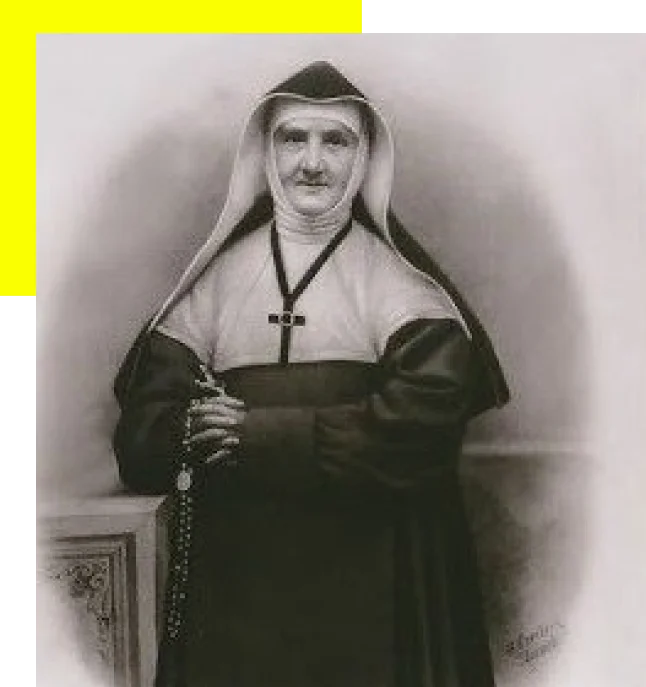
The Founder of St. Pauls Boarding and Day School
The foundation of St. Paul's Boarding and Day School is inseparably linked to the life, vision and enduring legacy of Blessed Marie Thérèse Haze, Foundress of the Congregation of the Daughters of the Cross, whose faith, courage and compassion shaped an educational mission that continues to serve the world today.
Born on February 28, 1782, in Liège, Belgium, Jeanne Haze was raised in a happy and deeply Christian family, living in comfortable circumstances. Her father served as secretary to the Prince-Bishop of Liège, a position that brought both privilege and, in time, profound hardship. The Revolutionary invasion of 1794 marked the beginning of immense suffering for the family. Forced to flee their homeland, they experienced exile, separation and uncertainty. Amidst the chaos, some children were separated from their parents and Jeanne's father, worn down by anxiety and fatigue, died in exile.
When the family eventually returned to Liège, they found themselves stripped of security, possessions and stability. Tragedy continued to follow them. Jeanne's only brother, who had pursued legal studies with determination, died suddenly just as he was about to begin his professional life. Left in difficult circumstances, Jeanne, her mother and sisters struggled to survive in a society devastated by war and its aftermath. While her other sisters married and established households of their own, Jeanne and her sister Ferdinande chose a different path, remaining with their mother until her death and dedicating their lives to caring for the poor and marginalised.
Their quiet life of service took a decisive turn when they were entrusted with a small fee-paying school, ensuring a modest livelihood. Soon after, they were invited to take charge of a poor parish school at St. Bartholomew's in Liège. Despite strong opposition from family and friends and the looming insecurity of poverty, Jeanne and Ferdinande accepted this responsibility, relinquishing their former school. This courageous decision marked a turning point in Jeanne's life, deepening her sense of vocation as an educator and servant of the poor.
Through years of suffering and loss, Jeanne found her deepest strength and inspiration in the Cross of Christ, which she came to see as the ultimate sign of God's boundless love for humanity. She felt called to respond to this love by recognising and serving Christ in every person she encountered. At a time when the French Revolution had suppressed religious life and successive governments in Belgium, including Dutch rule, prohibited entry into religious congregations, Jeanne could not pursue a traditional religious vocation. Yet, her faith, resilience and openness to God's will gradually gave rise to a bold idea—the foundation of a new religious family.
With her sister Ferdinande and three other companions, Jeanne embarked on this path of faith and hope. A young parish curate, Father John William Habets, agreed to become the spiritual guide of the group. Initially hesitant about a new foundation, he later embraced the mission wholeheartedly, offering his unwavering support. The Belgian Revolution of 1830 and the country's subsequent independence transformed the social and religious climate, making it possible to establish new religious communities.
On September 8, 1833, Jeanne Haze and her companions pronounced their vows, marking the official beginning of the Congregation of the Daughters of the Cross. Jeanne took the name Mother Marie Thérèse, and the Cross-chosen long before-became the defining symbol of the Congregation's spirituality and mission.
The early years were marked by trials. Within two years, three of the first companions died, and internal challenges tested Mother Marie Thérèse's leadership. Yet, sustained by faith and perseverance, the Congregation grew steadily. While education was the original mission, their work soon expanded to include care for the sick in their homes, support for orphans, and assistance to girls and women in moral danger or in prison. This openness to serve wherever there was need became a defining hallmark of Mother Marie Thérèse's spirit.
Her response to suffering was immediate and compassionate. The Sisters cared for victims of cholera during the epidemics of 1849 and 1866, tended to wounded soldiers during the wars of 1866 and 1870, and continued to adapt their mission to the urgent needs of society. As early as 1851, the Congregation expanded into Germany, followed by missions to India in 1862 and England in 1863. With the steadfast support of Father Habets—later Canon Habets-Mother Marie Thérèse continued to establish foundations across continents. His role was so significant that he is often regarded as co-founder, for without his dedication, the rapid expansion of the Congregation would not have been possible.
Mother Marie Thérèse Haze and Canon Habets both passed away in 1876, she on January 7, and he on December 29. Yet, their legacy lives on. Today, the Congregation of the Daughters of the Cross continues its mission across the world, with communities in Belgium, Germany, England, India, Italy, Ireland, Pakistan, Nepal and Brazil.
The spirit of education rooted in faith, compassion and service, envisioned by Blessed Marie Thérèse Haze, continues to guide institutions such as St. Paul's Boarding and Day School, where young girls are educated not only for academic excellence, but also for lives of purpose, dignity and service to society.